Roaring Twenties Bingo review
The twenties roared and then crashed (October 1929), which is a fair description of a bingo card as well. Roaring Twenties Bingo, a "specialty game" of RealTime Gaming (the studio's own label for the games that are neither slots nor tables), dresses the old game of numbers in the gold lettering and the red velvet of a jazz club, and we played it in "demo" mode (free play, with credits of no value) before writing these lines, which is how every game on this site was tried.
This page carries no rating, because the game was tried for the pleasure of describing it, and the figures below (up to one hundred cards per round, five Extra Balls, three progressive jackpots) are those that the game prints. The theoretical return is the exception, since the studio prints none and leaves it to each casino, as it does with its slots.
How Roaring Twenties Bingo plays
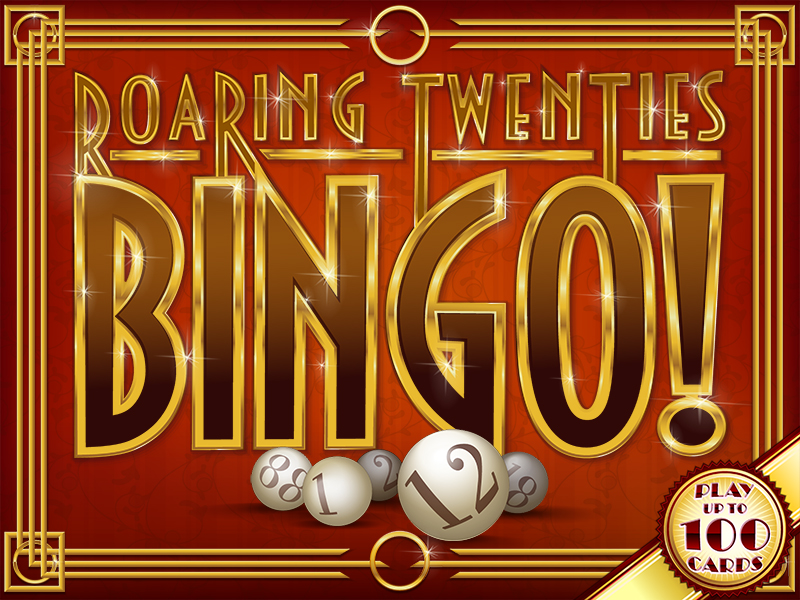
A "video bingo" is bingo without the hall: nobody sits across the table, nobody shouts, and the player buys the cards from the machine, which draws the balls and pays according to a table of patterns, so that the only opponent is the arithmetic, as in a slot. The splash screen promises up to one hundred cards, and the setting of a round takes three choices.
The first choice is the bet per card, the second is the number of cards in play at once, the third is the number of "turns" (consecutive rounds that the machine plays with the same cards, up to one hundred). The "Extra Balls" option, to which we return below, is switched on or off before the balls drop. The total of the round appears on the screen before the first ball, and it is the figure that you should read twice.
The card is a grid of twenty-five numbers (five by five), as the rules of the Maxi jackpot make clear, and the patterns that pay are drawn on the screen beside it, with the prize that each one carries. The balls fall quickly, the numbers light up by themselves, and after two rounds the crowded layout reads like any bingo card. The sound, which belongs to the setting, can be switched off.
The Extra Balls and the three jackpots
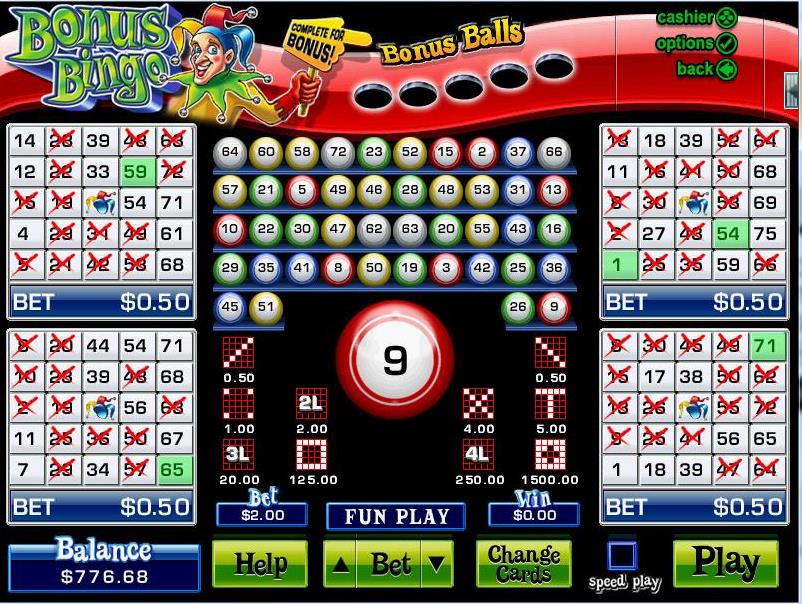
The "Extra Balls" option adds five balls to the draw and, as the game's own note puts it, doubles the potential winnings, since five more balls are five more chances of completing a pattern before the round closes. It changes the price of the round as well, and a player who plays twenty cards with the option on is making a larger bet than the bet per card suggests. The screen shows the total, and the total is the stake.
Three "progressive" jackpots (prizes fed by a slice of every bet, which grow until somebody wins them and restart from a "seed") sit above the cards. The "Maxi" is paid to a card on which all twenty-five numbers are called, a "coverall" or "blackout" in the language of the halls, while the "Major" and the "Mini" fall at random after a draw. Two of the three, therefore, do not depend on the card at all.
The arithmetic deserves one example: a player who buys ten cards at 0.10 each plays a round of 1.00 (ten by 0.10), and a hundred of credit lasts a hundred rounds, while the same player with a hundred cards plays rounds of 10.00 and is out of credit after ten, whatever the patterns do!
The two random jackpots fall after a draw rather than after a pattern, so that a round with few cards is in the running as well; the amounts of the three prizes appear on the screen, in play credits when the game runs in demo (they are then worth nothing) and in the currency of the account otherwise.
The return set by the casino, and the temper of the game
RealTime Gaming prints no theoretical return for Roaring Twenties Bingo: the "RTP" (the share of the stakes returned to the players over millions of rounds) is set by each casino among the settings that the studio offers. It appears, where it appears at all, in the "help" pages of the game, which few players read, and the "house edge" (what the casino keeps, one hundred minus the RTP) changes with it from one house to the next.
A bingo of this kind behaves like a slot of medium volatility, in our experience, since the small patterns pay often and little, the coverall almost never. The balance of a player who keeps the round small drifts for a long time before it decides, while the balance of a player who buys a hundred cards decides within a quarter of an hour! We would advise a newcomer to start with a handful of cards and the option off.
Where to play it, and the demo
Roaring Twenties Bingo sits among the specialty games of the casinos carrying RealTime Gaming, the Deckmedia houses first (SlotoCash, Uptown Aces, Uptown Pokies, Fair Go, Ozwin and Decode), which address the international market under a licence of Curaçao, that is an "offshore" licence. Our SlotoCash review says what such a licence is worth in practice, and our list of no-deposit bingo offers and our world list of no-deposit bonuses gather the offers that those houses publish.
The offers can change, the casino's own page prevails, and the demo, which is the way we tried it, opens at most of these houses after registration, as "practice" play, with the "Fun Play" button that the specialty games share with the slots. A "free chip" (a no-deposit bonus of a few dollars) is the other way to see the jazz club if you would rather not pay with your own money.
Its "wagering" (the number of times the bonus must be bet) and its "max cashout" (the ceiling on withdrawals) must be read first, as our page on free spins explains. The terms of many casinos count the bets on bingo and other specialty games differently from the bets on slots, sometimes in full and sometimes not at all; the clause is short, which is why it is worth finding before the first card.
Ad disclosure: some casino links are affiliate links; we may earn a commission at no extra cost to you. It never affects our ratings. 18+.
Markets: the operators listed on our pages address the international, non-regulated market and do not hold a licence in every country from which our readers arrive: before registering, it is the player's responsibility to check that the law of the country in which he or she is located allows playing with that operator.
Our opinion, without a rating
Roaring Twenties Bingo is a change of air from the reels, and it asks of the player what every bingo asks: a few cards, a modest stake per card and the patience of the halls, where the coverall is a legend more than a memory. In its favour stand the three jackpots, the Extra Balls and a setting that is drawn with taste; against it, the unpublished return and a price that grows faster than it looks.
For a player who likes numbers more than symbols, it is in our view the most pleasant of the specialty games of RealTime Gaming that we have tried; it is to be approached in demo first, with ten cards and a stopwatch, which is how we did it. A player who wants the reels will find them in Coyote Cash and Fruit Frenzy, of the same studio. The hub of slot and game reviews lists the rest, with the keno of 2015 kept as testimony (18+).
Frequently asked questions
No: it is a solo video bingo, in which the machine draws the balls and pays according to a table of patterns, so the only opponent is the arithmetic of the game, as in a slot. The round starts whenever the player presses the button rather than at the hour of a hall.
The Maxi is paid to a card on which all twenty-five numbers are called (a coverall). The Major and the Mini are random prizes that fall after a draw, whatever the pattern in progress, and all three are progressive, fed by a slice of every bet, with their amounts on the screen.
The option adds five balls to the draw of each round and, as the game's note puts it, doubles the potential winnings, since five more balls are five more chances of completing a pattern. It also raises the price of the round, which the screen shows before the first ball drops.
RealTime Gaming does not publish one figure: the return is set by each casino within the settings of the studio, so the help pages of the game at the casino where you play are the only place where it appears, and two casinos can pay back differently with the same cards. The demo runs the same mathematics and costs nothing.
By the Online-Casinos.ws editorial team · Online since 2002 · Last updated: 9 October 2026