Backgammon, rummy and the other skill games: the no deposit offers, from the 2000s to today
In the middle of the 2000s, in the wake of the poker boom, the web filled with "skill games": backgammon, rummy in its variants (Gin Rummy, Kalooki, Oklahoma), dominoes, chess and even arcade games of the Arkanoid kind, played against other people for money, which is what set them apart from the casino games. They were played as tournaments, with a "fee" (the entry price) and a prize pool made of the fees. Rooms were born for them alone, and the big casino brands opened "arcade" sections of their own.
Most of that has gone, and this page tells the story honestly rather than pretending that a list of no deposit offers for backgammon still exists. It says how those rooms earned their money, what their free offers were worth, why they closed and where the games survive; the links in the sidebar are to casinos of this site (with their ordinary offers as published), and none of them is a skill game room.
Ad disclosure: some casino links are affiliate links; we may earn a commission at no extra cost to you. It never affects our ratings. 18+.
Markets: the operators listed on our pages address the international, non-regulated market and do not hold a licence in every country from which our readers arrive: before registering, it is the player's responsibility to check that the law of the country in which he or she is located allows playing with that operator.
How a skill game room earned its money, and what "free" meant there
A skill game room was closer to a poker room than to a casino. The players played against one another, and the house kept a share of the entry fees of each tournament (ten to twenty per cent was the common range, by our memory of the rooms we visited) rather than a "house edge" built into the game; a backgammon match for $10 a head paid, say, $17 to the winner, and the $3 of difference were the room's income.
The no deposit offers followed from that economy, and they were small. A "free bankroll" of $5 at registration was common (BGRoom, the best known backgammon room, offered exactly that, with a "match" of one hundred per cent up to $100 on the first deposit), and it could be withdrawn only after a stated volume of entry fees had been paid (the skill room's form of "wagering"). The money went from the newcomer to the better players, and the room kept its share of every fee on the way.
The arithmetic was less generous than it looked, and it is worth doing once. A player who received $5 and had to pay $50 of entry fees before withdrawing (ten times the bonus, a mild figure) left $7.50 to the room at fifteen per cent of the fees, that is more than the gift itself. The rest of the $50 went to whoever played better, which was rarely the newcomer. A room that gave $5 to a thousand newcomers had, in effect, bought $50,000 of tournament entries!
BGRoom, and the rooms that closed with it
BGRoom was, in the memory of the trade, the most famous backgammon room online, with software of its own (downloaded to the computer, as was the rule then), realistic graphics for the time, "sit and go" tournaments (matches that started when the table was full) and a "lobby" where the player could follow his statistics and choose an "avatar". It closed after about ten years of activity, and nothing here is a current offer of it; the rummy rooms of the same years, which ran tournaments in the Gin, Kalooki and Oklahoma variants, closed or merged in the same period.
Three causes explain the decline, in our view. The poker boom that had carried the skill games ended around 2011, when the big rooms lost the American market. The casual player who had tried backgammon "because it was next to the poker tables" went elsewhere, and the smartphone then moved that player to free "apps", where the same games are played for points. The regulated markets (Italy among the first) asked for national licences that a small room could not afford, and the international rooms shrank to a handful.
What survives is honest but small: a few backgammon and rummy rooms for money, mostly in national markets under their own rules, which we do not follow and cannot verify; the free versions in the app stores pay nothing and ask nothing. We would rather say that than print a card for a room whose licence we have not read, which is why this page has no cards of its own.
888 Games and the "arcade" sections of the casinos
The casino brands answered the fashion with sections of their own, since the public was there. 888 (on this site with its casino) opened one called "Arcade", later "888 Games", in which skill tournaments stood beside "scratch cards", instant games and video slots drawn like arcade games. The core of an online casino was and remains the table games and the slots, and the skill tournaments were a way of bringing a different public to them.
We keep below, as a document of that time, the screenshot of one of those slots, "Call of Duty 4" (a video slot of twenty-five paylines taken from the video game), whose instructions we reproduced on this page when the section was open, as a curiosity for the readers of the time.
The soldier symbol stood in for every other except the scatter logo, five soldiers multiplied the bet by five thousand, and three or more logos opened a feature of free games with a multiplier up to five times (every soldier hit paid up to four more free games, and "headshots" paid a bonus).
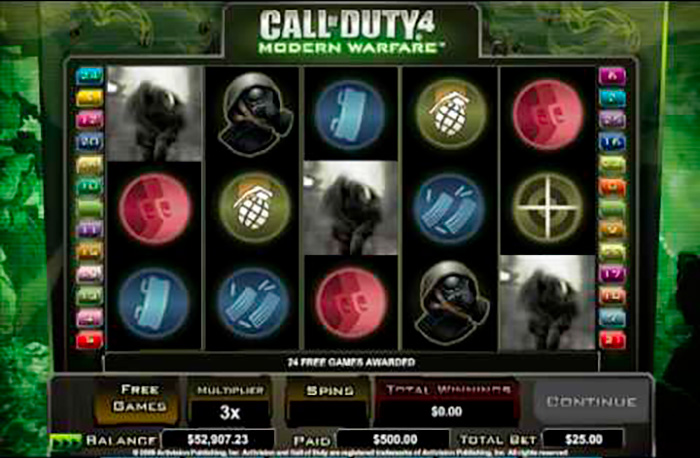
The general instructions printed under every slot of that section were those of any slot of the time: the lines were chosen with the arrows or the buttons beside the reels, the bet per line with the arrows of the bet window, and the total bet was lines times bet per line.
Wins were paid left to right on active lines (scatter and bonus symbols anywhere), only the highest win on each line was paid, and the "autoplay" button spun for the player and paused for the bonus rounds. Whether the section is still reachable today depends on the market, and we make no claim about it.
What a skill game is, and what it is not
A game of skill is one in which, over many matches, the better player wins more often than chance would allow, which is true of backgammon (where the dice decide a match and the "bearing off" decides a season), of rummy and of chess. Some countries treat these games differently from the casino games in their laws (the "skill" label is a legal category in several of them). That does not make them free of risk, since a newcomer who plays for money against regulars is the regulars' income, as the arithmetic above shows.
The casino games of this site are another matter, decided by the "RTP" (the return to player printed by the game) and by nothing the player does, except in blackjack and video poker, where the strategy moves the figure by a point or two. A player who wants free play with a chance of winning will find the real no deposit offers on our world list, and the room games of the same family on our pages on no deposit poker and no deposit bingo.
This page cannot know the country from which you arrive, and the offers in the sidebar may not be the ones shown to you, as the markets box says. The figures on the skill rooms above (fifteen per cent, ten times) are the common ones of those years, given as examples from memory, and nothing on this page is a current offer of a skill game room. The About page tells our method in full, the affiliate commission included.
Frequently asked questions
A few rooms for money survive, mostly in national markets under their own rules, and we do not list them because we have not read their licences or their terms. The free bankrolls of the 2000s ($5 at registration, released after a volume of entry fees) have gone with the rooms that offered them.
From a share of the entry fees of each tournament (ten to twenty per cent was the common range), since the players played against one another and the house had no edge in the game itself. A match for $10 a head that paid $17 to the winner left $3 to the room.
The best known backgammon room of the 2000s, with software of its own and a free bankroll of $5 at registration, which closed after about ten years; we keep its name here as a record of that time, not as an offer. The same goes for every figure in its section.
The poker boom that carried them ended around 2011, the smartphone moved the casual player to free apps (where the same games are played for points), and the regulated markets asked for national licences that a small room could not afford. The international rooms shrank to a handful, and most of the famous names closed.
Safer from the house, not from the opponent: there is no house edge in the game, but a newcomer who plays for money against regulars pays them, match after match, and the room keeps its share of every fee. The same game, when it is played for points in an app, costs nothing at all.
The skill game rooms were a chapter of the online gambling of the 2000s, and we keep this page as its record rather than as a list, because a record that says "closed" is more useful to you than a card that says "free"! 18+, and the law of the country where you are located decides whether playing with the operators in the sidebar is allowed.
By the Online-Casinos.ws editorial team · Online since 2002 · Last updated: 9 October 2026